The Bibendum occupies a corner site with South Street at 1 Grange Road, directly opposite the ornate Town Hall (dating from 1886) in the Little Chelsea district of this East Sussex seaside resort. It was listed in the 1995 CAMRA Good Beer Guide under its original name of the New Inn and appeared in the 1987 guide as a Chef and Brewer outlet. Real ale is still available but as the present name suggests, Bibendum is more bistro than public house. I’m not in any case Blogging about the beer. This was formerly a house of the Brighton-based Tamplin & Sons brewery (see my Blog post of 18th September 2011) and it retains some interesting architectural features.
The New Inn was rebuilt in 1880 - as the datestone high up on the corner elevation helpfully informs us - in three and a half storeys of sturdy redbrick. Two projecting gabled bays on the Grange Road side flank a Gothic-arched doorway, once the lobby entrance to the hotel side of the business. Very English in design is this building, almost Norman Shaw modest garden suburb - except, that is, for the ground floor frontage on the blue and brown banded glazed tiled plinth that wraps itself about the corner site extending into South Street.
With their pilasters and scrolled pediments, the four ex-entrances in this frontage and the door to the still-in-use corner vestibule are framed by classical motifs; but the inscriptions on the entablatures naming the rooms they once gave access to are decidedly art-nouveau in style as is the coloured glass design of delicate tracery in the arched windows. I would guess that this frontage was fitted in the fin de siècle of pub building, c. 1898-1900.
In my Blog post of 12th August 2011, I used the example of the Dorset, Brighton, to show how late-Victorian pubs were once divided into rooms that reflected class and status divisions of the time. The interior of Bibendum is now completely opened up with scant surviving fittings, but moving from the hotel lobby clockwise into South Street, we can tell from the entrances and extant etched window glass that it was once compartmentalised by screens into Saloon Bar, Public Bar, Jug Department and a Private Bar.
As is also the case with the Dorset, another ex-Tamplins pub, a bird is etched in the glass of one of the surviving old windows of what was once the New Inn. Birds of various kinds in the glasswork appear to have been a common motif for the brewery at the time.
Friday, 27 July 2012
Friday, 20 July 2012
The Bevy - More Than a Pub
A group of residents in the Moulsecoomb and Bevendean area of Brighton has formed as a co-operative to reopen their local, the Bevendean Hotel, on Hillside. After the pub was closed down by the police in May 2010 the building was purchased by the East Brighton Trust who converted the upper floor into flats. The local residents won a bid to convert the gutted ground floor into a pub, café, meeting place and kitchen serving the local community. A successful open day was recently held at the pub, with over seventy attendees ranging from older locals from the pigeon club to young families to members of Father John’s church congregation, all desperate for a community space and most handing over their details and telling the co-op about the wide range of practical skills they have.The co-op is currently preparing to start fundraising. Donations will be converted into shares when the prospectus is launched. A number of local micro breweries are very interested and excited by the project. If you can contribute to the economic and social capital required to make the Bevy venture work, the pub co-op mobile is 07435 649161; donation details can be found at http://www.thebevy.co.uk/donation.html; there is a Facebook page at http://www.facebook.com/#!/TheBevy
A few local people remain understandably apprehensive but hopefully as the co-op’s strapline says, the Bevy will be so much more than just a pub. As one couple from Hillside said "just where can you go to meet your neighbours round here?"
My thanks to Warren Carter, Co-op Chair and Darren Edwards, Committee Member, for supplying the original copy from which this Blog was created. Thanks also for their permission to use images from the Bevendean Cooperative Pub Facebook page.
Thursday, 12 July 2012
The Lion and Unicorn, Brighton - Once a House of Repute in Sussex
As can be adduced by the architect’s plans of the period, Griffin might have added that the WC and urinal was also next to the central staircase and a Kitchen and the Recreation Room, as well as being adjacent to the Private Bar, all to the right side of the south, Sussex Street end of the premises. There was no supervision of the Private Bar from the bar counter to the left, which served a Public Bar, Bottle & Jug and Bar Parlour. Beyond this, at the north end of the ground floor was located the tenant’s private Sitting Room, Kitchen and Scullery and the rear yard.
Proposals for the improvement of the pub had already been drawn up by 7th September 1924 by the KTB in-house architects J. L. Denman & Son. These can be summarised from letters and plans of the period as follows:
(i) The removal of the central staircase, WC and urinal and of the present ground floor partitions, creating along the south, Sussex Street end a larger Public Bar to the left and Recreation Room to the right; (ii) the extension of the premises to the north by the incorporation of a small cottage, No. 3 Claremont Place to provide a Private Bar at the north-west and to create new and greatly improved public urinal in the extended north-east yard, including the erection of lavatory accommodation for women; (iii) the placing of the serving counter at the centre of the ground floor to afford supervision of all the ground floor bars; (iv) a new staircase formed at the north end, from the ground to first floor, thus separating the tenant’s upstairs private accommodation from the rest of the premises; (v) at the side of the public bar facing Claremont Place (i.e. at the west wall) it is proposed to make a small passage to the bar counter, for use as a Bottle & Jug department (although this was re situated on the south side when the alterations took place in 1927).
“The Lion & Unicorn in Sussex Street shows how restraint in design can serve good taste – an outstanding example of admirable effect gained by the most simple means – largely a matter of laying bricks with some thought instead of in a purely mechanical fashion” (c. 1932, p. 28)
“Restraint” and “good taste” are here conveyed in “admirable effect” though Denman’s favoured neo-Georgian motifs: portico entrances, elongated sash windows and modelled panels coursing along the brickwork below the pediment.
Of the doorways, incidentally, that on the far left is the lobby to the Private Bar, the centre is the lobby entrance to the Public Bar and at the right is accessed the Bottle & Jug, eventually constructed at the south end of the premises and entered though a lobby between the Public Bar and Recreation Room. The tenant by the time of the completion of these improvements was a William Herbert Peters. The ideology of public house improvement was driven by a faith in ‘environmentalism’: the belief that larger, more salubrious surroundings effected in good design, with decent provision of seating and catering, would enable a corresponding restraint in the attitudes and behaviour of the customers. Notwithstanding this general objective, some more specific themes of desirability keep arising in archived discussions of the time, these being: first, to allow supervision of the whole licensed premises from the serving counter; second, to wholly separate access to the tenant’s private accommodation from that to the licensed part of the premises; third, to improve sanitary accommodation, which often included the provision of ladies’ lavatories for the first time; fourth, to balance the outcome of such advances against concerns that an increase in beer consumption, and thus drunkenness, could be facilitated. For as the Chief Constable somewhat ambivalently ended his aforementioned letter of 6th September 1926 regarding the proposed improvements to the Lion and Unicorn: “if sanctioned, drinking facilities will be greatly increased, but a great improvement would be effected”.
The Lion and Unicorn was once known locally as “The Blue House”, although none of the reasons put forward to explain this colloquialism – that it was frequented by off-duty members of the police force, that it had blue tiles or was painted blue, or that the language used by the customers was ‘blue’ – is particularly convincing. Certainly, Denman-designed pubs placed emphasis on their brickwork and not tiles.
Sources:
Kemp Town Brewery (n.d. but c. 1932), In and Around Brighton: “Houses” of Repute in Sussex, Cheltenham: Ed J. Burrow & Co.
National Archives, East Sussex Record Office, Brighton Borough Petty Sessional Division, PTS/2/9/334, http://www.nationalarchives.gov.uk/a2a/records.aspx?cat=179-pts2&cid=9-363&kw=East%20Sussex%20Record%20Office#9-363
Wednesday, 27 June 2012
Regarding: Shut up about Barclay Perkins: Let's Brew Wednesday - 1948 Portsmouth and Brighton United Breweries Pompey Royal
And here is what esteemed beer historian Ron Pattison has made of the beer I've been Blogging about:
Shut up about Barclay Perkins: Let's Brew Wednesday - 1948 Portsmouth and Brighton United Breweries Pompey Royal
If I've left Ron "feeling all superfluous" then I must have been doing a good job!
Shut up about Barclay Perkins: Let's Brew Wednesday - 1948 Portsmouth and Brighton United Breweries Pompey Royal
If I've left Ron "feeling all superfluous" then I must have been doing a good job!
All Brewing’s Cancelled
Eley goes onto say that “United were completely reliant on other brewers for their beer supplies from January until August 1941 when brewing recommenced”. An analysis of the brewing book confirms that the brews of XX and PB planned for 13th January, and of IPA and XX for the 14th January were all cancelled and that it was not until 3rd August 1941 that the next brew took place, with XX. Even so, perhaps United got off relatively lightly. Long’s brewery, just a short Southsea-hop away at the corner of Hambrook Street and Cecil Place, took a direct hit in the blitz and was completely devastated.
Thursday, 14 June 2012
Anchor Springs Hornblower
At 4.5% ABV, 1045° OG, Hornblower is brewed with pale, crystal, chocolate and amber malts. Challenger is used as the bittering hop with Target in the middle and EKG at the end. Light notes of berry fruits on the nose; decidedly sweet initial taste; biscuit malt in the mouth; delicate milk chocolate and redcurrant mix on the palate; brewer Frank McCabe’s trademark lingering hop finish; all aspects combine to create a superb bitter-sweet balance to this lightly-hopped, copper-coloured traditional beer.
Friday, 25 May 2012
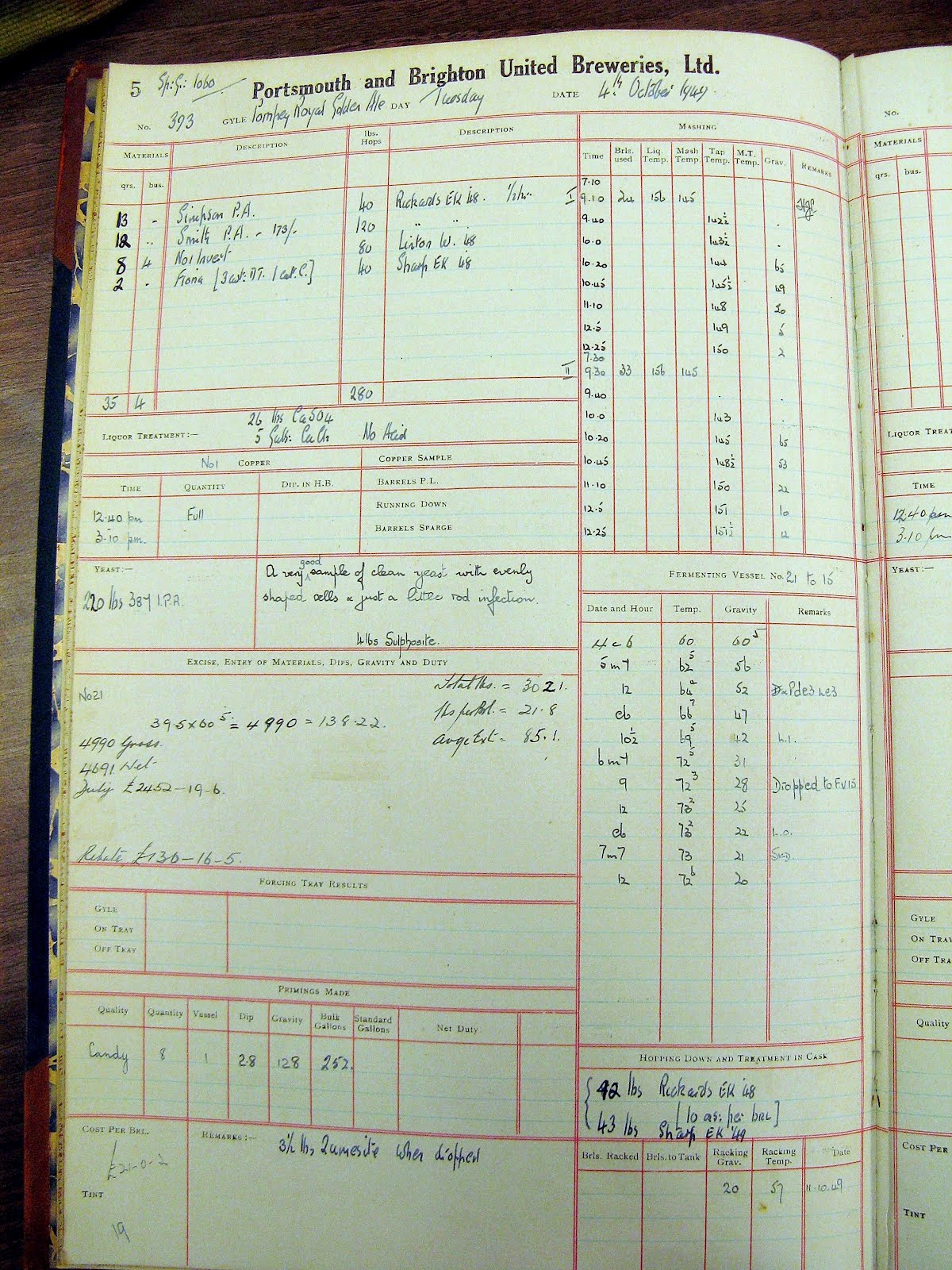
Portsmouth and Brighton United Breweries Pompey Royal: A Beer Not Originally Brewed for the Queen’s Coronation
Pompey Royal was first brewed in Southsea by Portsmouth and Brighton United Breweries (henceforth P&BUB). A beer of that name is now brewed in nearby Gosport by Oakleaf Brewing Co Ltd. Three of my Blog posts from about a year ago traced the genealogy of the beer of this name. I discovered how it migrated from its original home at King Street, Southsea, taking at first just a short hop to Brickwoods of Portsea, before being banished in the 1980s by Whitbread to far-flung Cheltenham, Gloucestershire and Faversham, Kent. Pompey Royal arrived back in Hampshire for a few years in the early 1990s, contract-brewed by Gales of Horndean. It was revived in 2008 by Oakleaf just a couple of miles from its old King Street site, which has now been replaced by housing.
Conventional wisdom has it that Pompey Royal was first brewed by P&BUB as a strong bottled-ale for the Queen’s Coronation in June 1953. In my Blog post of 5th May 2011, I cast doubt on that claim based on my reading of a 1994 Portsmouth Papers publication by Philp Eley. Upon discovering his name mentioned in my Blog post, Mr Eley was kind enough to email me the relevant extracts he took from the P&BUB Minute Books when consulting the Whitbread Archive in undertaking the research for his 1994 publication. These supported the conclusions I had already drawn from Mr Eley’s work and I am grateful to credit him here for both the original inspiration and for the reproduction of some of those extracts in what follows. Having now consulted the P&BUB King Street Brewing Books for the period 1940-1954, located at the Portsmouth History Centre, I can confirm that Pompey Royal was not originally brewed for the present monarch’s coronation in 1953. I was leafing my way towards the end of the brewing book for the period 23rd February to 8th December 1948, running my eye along the initials of the beers (this shorthand being a habit of the Head Brewer) and their corresponding succession of low gravity figures when I was brought up sharp by a column entry of 605. Up quick to the top of the page expecting to see PR where, instead, the Head Brewer had written out the whole name, Pompey Royal, for its first ever brew on Wednesday 27th October 1948.
Philip Eley’s notes had already confirmed that P&BUB had considered “’baby’ sized bottlings of Pompey Royal” as early as 8th March 1949. The minute book for 12th October 1949 states “Pompey Royal ‘Golden Ale’ to be marketed from 14th November [of that year] at 12/3d per dozen halfpints and sold to public at 15/-; usual discounts to free trade”. The brewing book for the period December 1948 to September 1949 is lost, but on Tuesday 4th October 1949 the Head Brewer has written Pompey Royal Golden Ale at the top of the page (below left) for what is possibly the second brew of the beer, still with a specific gravity of 1060˚ but now with a somewhat changed recipe.
I am not disputing that Pompey Royal Golden Ale was brewed during the occasion of the Queen’s coronation - a brew took place on 30th May 1953 - and may have been released as a Coronation Ale. But a beer of that exact name and original gravity was brewed and marketed by 1949 with the first ever brew of Pompey Royal having taken place in October 1948, more than three years before the death of King George VI. Philip Eley suggests that Brickwoods replaced bottled United Pompey Royal in 1962, and this would leave the name available for the re-branding as Pompey Royal of cask Brickwoods Best in the late 1970s.
Sources:
Eley, P. (1994) Portsmouth breweries since 1847, The Portsmouth Papers, 63, Portsmouth: Portsmouth City Council Civic Offices.
Personal email correspondence from Philip Eley to David Muggleton, 15th November 2011
Portsmouth Museums and Records Services, National Archives, Portsmouth & Brighton United Breweries Ltd, King Street Brewing Book 1948, 412A/7/33, http://www.nationalarchives.gov.uk/nra/onlinelists/GB0042%20412A.pdf
Subscribe to:
Posts (Atom)