Thursday, 14 June 2012

Anchor Springs Hornblower

 
At 4.5% ABV, 1045° OG, Hornblower is brewed with pale, crystal, chocolate and amber malts. Challenger is used as the bittering hop with Target in the middle and EKG at the end. Light notes of berry fruits on the nose; decidedly sweet initial taste; biscuit malt in the mouth; delicate milk chocolate and redcurrant mix on the palate; brewer Frank McCabe’s trademark lingering hop finish; all aspects combine to create a superb bitter-sweet balance to this lightly-hopped, copper-coloured traditional beer.

Friday, 25 May 2012

Portsmouth and Brighton United Breweries Pompey Royal: A Beer Not Originally Brewed for the Queen’s Coronation

Pompey Royal was first brewed in Southsea by Portsmouth and Brighton United Breweries (henceforth P&BUB). A beer of that name is now brewed in nearby Gosport by Oakleaf Brewing Co Ltd. Three of my Blog posts from about a year ago traced the genealogy of the beer of this name. I discovered how it migrated from its original home at King Street, Southsea, taking at first just a short hop to Brickwoods of Portsea, before being banished in the 1980s by Whitbread to far-flung Cheltenham, Gloucestershire and Faversham, Kent. Pompey Royal arrived back in Hampshire for a few years in the early 1990s, contract-brewed by Gales of Horndean. It was revived in 2008 by Oakleaf just a couple of miles from its old King Street site, which has now been replaced by housing.

Conventional wisdom has it that Pompey Royal was first brewed by P&BUB as a strong bottled-ale for the Queen’s Coronation in June 1953. In my Blog post of 5th May 2011, I cast doubt on that claim based on my reading of a 1994 Portsmouth Papers publication by Philp Eley. Upon discovering his name mentioned in my Blog post, Mr Eley was kind enough to email me the relevant extracts he took from the P&BUB Minute Books when consulting the Whitbread Archive in undertaking the research for his 1994 publication. These supported the conclusions I had already drawn from Mr Eley’s work and I am grateful to credit him here for both the original inspiration and for the reproduction of some of those extracts in what follows.

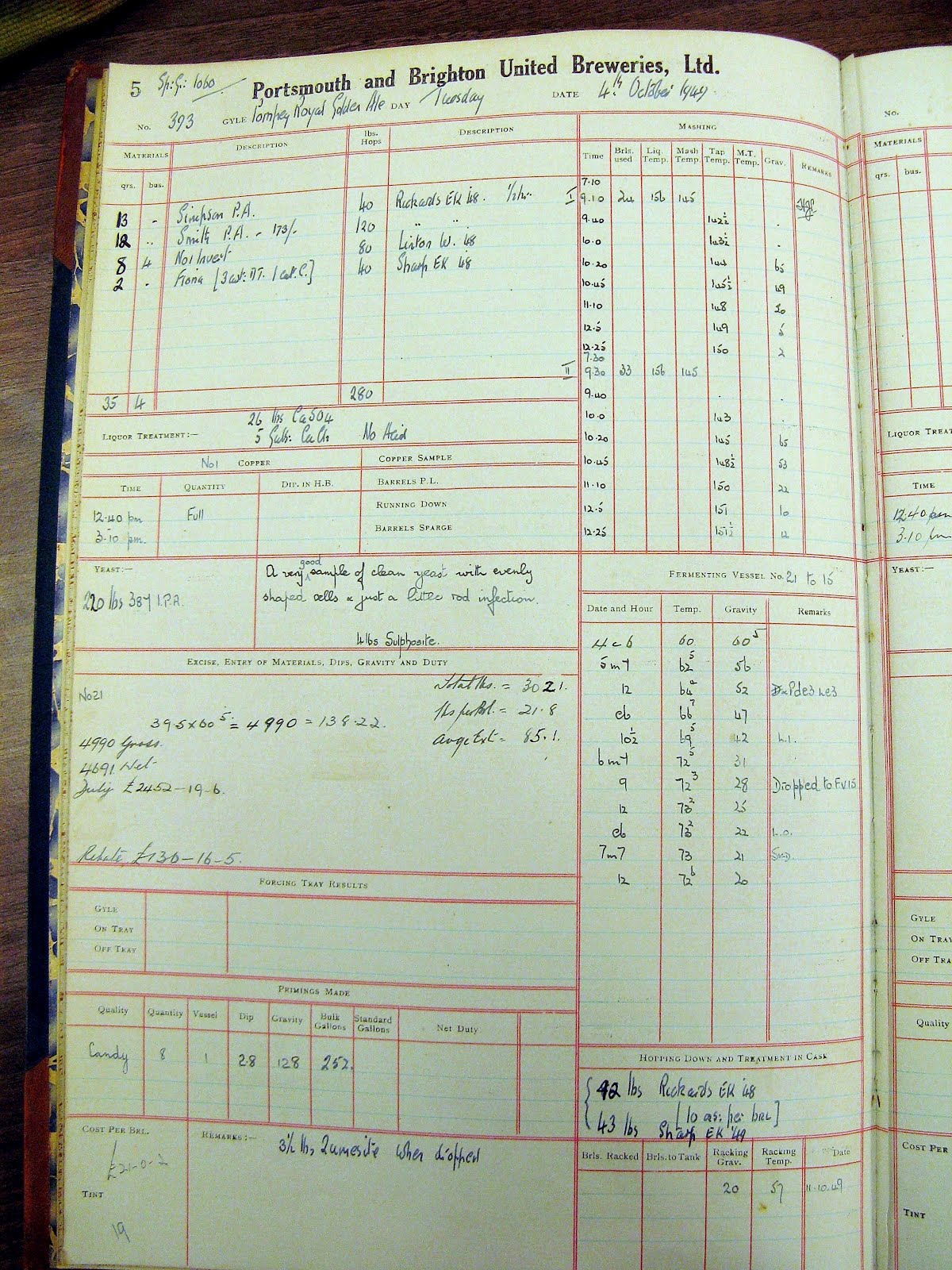
Having now consulted the P&BUB King Street Brewing Books for the period 1940-1954, located at the Portsmouth History Centre, I can confirm that Pompey Royal was not originally brewed for the present monarch’s coronation in 1953. I was leafing my way towards the end of the brewing book for the period 23rd February to 8th December 1948, running my eye along the initials of the beers (this shorthand being a habit of the Head Brewer) and their corresponding succession of low gravity figures when I was brought up sharp by a column entry of 605. Up quick to the top of the page expecting to see PR where, instead, the Head Brewer had written out the whole name, Pompey Royal, for its first ever brew on Wednesday 27th October 1948.

Philip Eley’s notes had already confirmed that P&BUB had considered “’baby’ sized bottlings of Pompey Royal” as early as 8th March 1949. The minute book for 12th October 1949 states “Pompey Royal ‘Golden Ale’ to be marketed from 14th November [of that year] at 12/3d per dozen halfpints and sold to public at 15/-; usual discounts to free trade”. The brewing book for the period December 1948 to September 1949 is lost, but on Tuesday 4th October 1949 the Head Brewer has written Pompey Royal Golden Ale at the top of the page (below left) for what is possibly the second brew of the beer, still with a specific gravity of 1060˚ but now with a somewhat changed recipe.
According to Philip Eley’s extracts from the 1952 minute books for February and March, the brewing report showed a “high overall loss due to bad results for Pompey Royal”. Whether this refers to a financial loss due to poor sales or to a problem in the production process is unclear. There is no mention of matters such as infections in the brewing spec for Pompey Royal on either the 7th January or 5th March 1952. In any case, Pompey Royal was brewed from October 1949 onwards in roughly monthly or two monthly intervals at least up until 4th May 1954, which is the last record available in the existing King Street brewing books.

I am not disputing that Pompey Royal Golden Ale was brewed during the occasion of the Queen’s coronation - a brew took place on 30th May 1953 - and may have been released as a Coronation Ale. But a beer of that exact name and original gravity was brewed and marketed by 1949 with the first ever brew of Pompey Royal having taken place in October 1948, more than three years before the death of King George VI. Philip Eley suggests that Brickwoods replaced bottled United Pompey Royal in 1962, and this would leave the name available for the re-branding as Pompey Royal of cask Brickwoods Best in the late 1970s.

Sources:

Eley, P. (1994) Portsmouth breweries since 1847, The Portsmouth Papers, 63, Portsmouth: Portsmouth City Council Civic Offices.

Personal email correspondence from Philip Eley to David Muggleton, 15th November 2011

Portsmouth Museums and Records Services, National Archives, Portsmouth & Brighton United Breweries Ltd, King Street Brewing Book 1948, 412A/7/33, http://www.nationalarchives.gov.uk/nra/onlinelists/GB0042%20412A.pdf

Friday, 11 May 2012

The Stand Up Inn, Lindfield

It was with great sadness that Dark Star brewery recently announced they would be leaving the Stand Up Inn, Lindfield as they had been unable to agree terms for a new lease that would enable them to cover their costs. The last day of trading was Sunday 29th May 2012. The following article on the pub was adopted from The Quaffer No. 26, June 2010, Lindfield Libations.

Situated on high ground above the upper reaches of the River Ouse, Lindfield is a village and civil parish in the heart of Sussex a mile north-east of Haywards Heath. It was first documented in 765 AD as a Saxon settlement, Lindefeldia, meaning ‘open land with lime trees’. Pollarded lime trees still line the picturesque High Street, a designated conservation area with over forty medieval and post-medieval timber-framed houses. By far the best pub in the village, at 47 High Street, is the Stand Up Inn.

Its distinctive timber framed shop-like frontage has small paned windows with dimpled glass. The left side, formerly Lloyds Bank, has exposed brickwork, thin timber framing and wood laminate floor. There is a bar billiards table and a dartboard to the rear. Beamed and arched ‘walk-throughs’ divide what is otherwise an open-plan right-side room with white plastered walls. Load bearing ceiling beams are lined with numerous pump clips. Chunky ‘rustic’ furniture and scrubbed tables stand on well worn carpet. Cushioned seating is in the window sill; benches are out in the paved and narrow back yard. A compact servery with plain hardboard front resides at the right. The name of Fanny Sara Durrant lives on in the old signboard next to her photograph above the counter and thereby hangs an interesting tale.

Sara’s husband, Edward Durrant had built the Stand Up by the 1880s as a beerhouse, primarily for the workmen of his brewery. Its name arose from the lack of chairs and tables in the bar, for Edward was an early pioneer of what was later to be called ‘perpendicular drinking’. This term was a disdainful one when it was employed by the evangelists of public-house ‘improvement’, for drinking while standing at the bar counter was seen to encourage copious consumption. Edward’s aim was not, however, to get his workforce to drink more but to hasten their departure.


Durrant’s brewery at No. 49 was located just to the rear of the passageway that connected the Stand Up to Edward’s other business, his drapery, grocery and glassware shop, and he wanted his men to promptly return to their duties, not sit lingering over a pint and game of dominoes. “Let ‘em stand up and drink up!” he was reported to have said. As the Harvest Beer at 2d a quart was disparagingly known as ‘Apron Washings’ the men might not been too concerned at having their daytime drinking curtailed; although a more palatable sounding London Porter and Double Porter were reputed to have been brewed, while locally advertised at 1s a gallon was a Family Bitter Ale.

The only Durrant’s Ale that readers may recall is the one brewed by Dark Star to commemorate the centenary of the closing of the brewery in July 1906. Upon the death of Edward in 1902, Sara had owned and run the Stand Up with son Bartley acting as the brewer until he emigrated. Durrant’s Brewery was finally sold with its four pub estate on 29th September 1909 to Ballard & Co. of Lewes. (Ballard & Co was taken over in 1924 by Page and Overton’s Brewery Ltd. This Croydon-based company was acquired five years later by Hoare and & Co Ltd, of London E1 who, in turn, were swallowed up in 1933 by local rivals Charrington & Co Ltd.) The Durrant brewery buildings became an extension to the family home and shop. From 1988-1999 they housed Ray Leworthy’s wireless museum. Now converted into a high quality residence, ‘The Old Brewery’ was recently on the market at £545K, perhaps not so high a price to pay for the privilege of living in Lindfield next door to the Stand Up Inn.
 

It was not to be until 1965 that Ye Olde Stand Up Inn, as the wine and beer house it was then tweely called, received a full licence. That was in the days of long-serving tenants Fred and Nellie Lambert when the interior was two small rooms. It had been owned by Charringtons from 1933 until a Noel McNally acquired the freehold in 1982 and changed its name to the Linden Tree after the mature lime tree outside. Noel also refurbished the interior on the grounds that “you could have had ballroom dancing behind the bar, but there was no room for the customers”. As the Linden Tree it was listed in the CAMRA Good Beer Guide from 1984-88 and 1990-2003. The Lloyds Bank property on the left closed in 1999/2000 and was incorporated into the pub c. 2002. The interior was modernised again by Dark Star upon their taking over the pub in October 2005 and restoring its original and most loved name.

Good Beer Guide-listed since 2005, this regular on the local CAMRA branch Ale Trail has three handpumps for Dark Star beers (Hophead, Best and Original on a spring visit) and three more for interesting guest ales such as Red Squirrel IPA, Hopdaemon Incubus, Shardlow Golden Hop and Salopian Shropshire Gold. Having been local CAMRA branch Country and Village Pub of the Year three times in the past, it is now the branch 2010 POTY overall runner-up. CAMRA POTY awards at branch, regional and national level have also been won for the cider and perry range. This on the last visit consisted of Moles Black Rat and Westons Old Rosie Cloudy Cider on handpump, Westons Country Perry on handpump, and, from Taunton, Sheppy’s Farmhouse Cider on gravity. Not only beer festivals but cider and cheese festivals are held regularly at this outstanding village pub.

Thursday, 3 May 2012

Adopt a Mild for May: Anchor Springs Mild

The Campaign for Real Ale (CAMRA) is asking people to adopt a mild for the month of May and persuade others to go out and try it. Although outselling bitter in 1950s Britain, mild became an endangered style during the 1990s but has once again regained popularity. This resurgence owes much to CAMRA’s Mild in May campaign.

Being a member of CAMRA’s Beer Styles Working Group and the Brewery Liaison Officer for Anchor Springs Brewery of Littlehampton, West Sussex, I made the not too difficult decision to promote and recommend Anchor Springs Mild.

At 3.8% ABV, 1045.5° OG, this is a fruity, full-bodied version of the style. Dark-brown and tawny-hued it is brewed with Pale, Crystal and Chocolate malts and hopped with Fuggles, Target and EKG. A slightly-sweet initial taste has light fruit and chocolate notes leading to just a hint of liquorice in a lingering finish.

Anchor Springs beers are regularly available at both the Spy Glass Inn, Marine Parade, Worthing, and the brewery tap, the Crown Inn, High Street, Littlehampton. Anchor Springs: a range of quality, premium beers to suit different palates for the discerning drinker.

Tuesday, 24 April 2012

Three Hampshire Beers

On the Easter Good Friday, 6th April,  I visited Portsmouth and sampled three beers from Hampshire microbreweries. At the White Swan, Guildhall Walk, a Wetherspoon outlet (left), I first tried a half of Upham Stakes Ale. Upham Brewery are based at Stakes Farm, Cross Lane, Upham, Hampshire. They began brewing in 2009 using a 3.5 barrel plant.

The Stakes Ale is a chestnut coloured beer with low carbonated head. Distinctive stilton notes on the nose with toffee-caramel and just a hint of grassy spearmint. Stilton again on the first taste along with toasted malt is followed by very peppery, spicy hop notes giving a lingering astringent finish. The flavours are restrained rather than demonstrative and rather too subtle for my personal tastes. The mouthfeel is smooth but a little thin and understates its 4.6% strength.

At the same pub I then sampled half of Oakleaf India Pale Ale.

Set up in 2000 by Ed Anderson and his father-in-law Dave Pickersgill, Oakleaf Brewing Company Ltd are at Unit 7, Clarence Wharf Industrial Estate, Mumby Road, Gosport, Hampshire. The IPA is a gold coloured version of this historic style with a froth of white lacing. Marmalade, tangerine, citrus hops - even peaches and cream are conveyed in the intense and complex aroma. The smooth and creamy body conveys the full alcoholic 5.5% strength. Hop bite carries through into the taste, initially underpinned by fruity malt but building to a powerfully bitter finish. Very enjoyable.


Later at the Sir Loin of Beef, Highland Road, in the Eastney area of the city, I had a half of Vibrant Forest Stormbrew. Experienced home-brewer Kevin Robinson is the Vibrant Forest Brewery. He began commercial brewing in the summer of 2011 from his home in Totton, Southampton, on the 1-barrel plant previously in use at Havant Brewery.

Stormbrew is a 4.7% dark amber/copper coloured beer with low carbonated head. Liqueur at first on the nose with plenty of milk chocolate notes. Chunky malt mouthfeel and burnt sweetness with dark fruits, treacle and even more chocolate define the character before an emerging bitterness becomes predominant. An excellent beer in my opinion.


Thursday, 12 April 2012

The Woodman, Brighton

You cannot have a drink in this early-Victorian built pub at  49 Guildford Street –  no one has for over sixty years, since the days in 1949 of its last ever licensee Fred Sparshott. But the photographs present a perfect example of its history literally etched on the exterior.


Faded but visible high up on the near corner above the street sign is THE WOODMAN. Very distinctly on the architrave above the Doric capitals of the Guildford Street door appears C. BRIGGS. In the recess below, appended almost apologetically is T. RICHARDS. Charles Briggs was the first recorded licensee in 1854 (I like to think that his customers in their conviviality called him Charlie). An F. Richards and a Mrs. Richards appear at this address in street directories of 1868. More difficult to discern is the scanty script on the stone wall to the right. Just traceable with some patience is:

VALLANCE & CATT’S
FINE ALES
LONDON STOUT

This is signage from the Victorian owners of Brighton’s defunct West Street Brewery - surely the only surviving example of its kind on a building. Those of you reading this Blog from outside of the UK will, I think, know what London Stout is. But as beer historian Ron Pattinson tells us, Fine Ales did not in those days did not mean ‘good ales’, as we would now understand the term, but ‘clear’, as in reference its clarification. Hence: finings used to clear beer. The advertising tablet below the window further along (scroll along the large photograph below) possibly once read BITTER ALE or perhaps the last word is PALE. Generically speaking, ale was lightly-hopped in comparison to the Bitter Beers and Pale Ales (which confusingly belong to the beer, not ale family) that became increasingly popular from the 1860s onwards.

Despite the dilapidated appearance of what was once the Woodman, the plastic doorbell, clean net curtains and two modern replacement windows make it obvious that the premises are occupied.

Postscript: these passages on the pub were originally written in 2009 for the ‘Brighton Heritage Pubs’ issue (No. 24) of The Quaffer magazine. It was put to me at the time that the signage, faded as it was, had survived at all only because the local Tamplin & Sons brewery had painted over it after acquiring the pub in 1899. The exterior had gradually given up its Victorian secrets as it decayed during the last six decades. Some months ago, when walking past the Woodman, I was taken aback to find the building looking smart and spruce. The names of the landlords had been spared but the brewery signage was completely obliterated, protected once more under a new coat of paint but no longer visible again for decades to come.
 

Tuesday, 3 April 2012

Anchor Springs Hornblower

At 4.5% ABV, 1045° OG, Hornblower is brewed with pale, crystal, chocolate and amber malts. Challenger is used as the bittering hop with Target in the middle and EKG at the end.

Light notes of berry fruits on the nose; decidedly sweet initial taste; biscuit malt in the mouth; delicate milk chocolate and redcurrant mix on the palate; brewer Frank McCabe’s trademark lingering hop finish.

All aspects combine to create a superb bitter-sweet balance to this lightly-hopped copper-coloured traditional beer.