Thursday, 12 July 2012

The Lion and Unicorn, Brighton - Once a House of Repute in Sussex


Like many thousands of pubs up and down the country before their ‘improvement’ during the interwar period, if the Lion and Unicorn was “a house of repute”, it was not for the reasons thought desirable by the brewery or licensing justices. In a letter dated 6th September 1926 to the town’s Licensing Justices, the Chief Constable of Brighton, Charles Griffin, wrote concerning this Kemp Town Brewery pub, “on the occasion of the inspection of the premises the bar was filled with customers, and the heat was oppressive. The smell from the urinal, which is now situated practically in the centre of the ground floor, was quite noticeable.”
As can be adduced by the architect’s plans of the period, Griffin might have added that the WC and urinal was also next to the central staircase and a Kitchen and the Recreation Room, as well as being adjacent to the Private Bar, all to the right side of the south, Sussex Street end of the premises. There was no supervision of the Private Bar from the bar counter to the left, which served a Public Bar, Bottle & Jug and Bar Parlour. Beyond this, at the north end of the ground floor was located the tenant’s private Sitting Room, Kitchen and Scullery and the rear yard.

Proposals for the improvement of the pub had already been drawn up by 7th September 1924 by the KTB in-house architects J. L. Denman & Son. These can be summarised from letters and plans of the period as follows:

(i) The removal of the central staircase, WC and urinal and of the present ground floor partitions, creating along the south, Sussex Street end a larger Public Bar to the left and Recreation Room to the right; (ii) the extension of the premises to the north by the incorporation of a small cottage, No. 3 Claremont Place to provide a Private Bar at the north-west and to create new and greatly improved public urinal in the extended north-east yard, including the erection of lavatory accommodation for women; (iii) the placing of the serving counter at the centre of the ground floor to afford supervision of all the ground floor bars; (iv) a new staircase formed at the north end, from the ground to first floor, thus separating the tenant’s upstairs private accommodation from the rest of the premises; (v) at the side of the public bar facing Claremont Place (i.e. at the west wall) it is proposed to make a small passage to the bar counter, for use as a Bottle & Jug department (although this was re situated on the south side when the alterations took place in 1927).

The south west corner of the building was set back or recessed at the time of the renovations and is facing us on the photograph taken from the brewery’s (c. 1932) book “Houses” of Repute in Sussex, from which the following passage is taken:

“The Lion & Unicorn in Sussex Street shows how restraint in design can serve good taste – an outstanding example of admirable effect gained by the most simple means – largely a matter of laying bricks with some thought instead of in a purely mechanical fashion” (c. 1932, p. 28)

“Restraint” and “good taste” are here conveyed in “admirable effect” though Denman’s favoured neo-Georgian motifs: portico entrances, elongated sash windows and modelled panels coursing along the brickwork below the pediment. Of the doorways, incidentally, that on the far left is the lobby to the Private Bar, the centre is the lobby entrance to the Public Bar and at the right is accessed the Bottle & Jug, eventually constructed at the south end of the premises and entered though a lobby between the Public Bar and Recreation Room. The tenant by the time of the completion of these improvements was a William Herbert Peters.


The ideology of public house improvement was driven by a faith in ‘environmentalism’: the belief that larger, more salubrious surroundings effected in good design, with decent provision of seating and catering, would enable a corresponding restraint in the attitudes and behaviour of the customers. Notwithstanding this general objective, some more specific themes of desirability keep arising in archived discussions of the time, these being: first, to allow supervision of the whole licensed premises from the serving counter; second, to wholly separate access to the tenant’s private accommodation from that to the licensed part of the premises; third, to improve sanitary accommodation, which often included the provision of ladies’ lavatories for the first time; fourth, to balance the outcome of such advances against concerns that an increase in beer consumption, and thus drunkenness, could be facilitated. For as the Chief Constable somewhat ambivalently ended his aforementioned letter of 6th September 1926 regarding the proposed improvements to the Lion and Unicorn: “if sanctioned, drinking facilities will be greatly increased, but a great improvement would be effected”.

The Lion and Unicorn was once known locally as “The Blue House”, although none of the reasons put forward to explain this colloquialism – that it was frequented by off-duty members of the police force, that it had blue tiles or was painted blue, or that the language used by the customers was ‘blue’ – is particularly convincing. Certainly, Denman-designed pubs placed emphasis on their brickwork and not tiles.

The landscape of this area of Brighton, from Edward Street to Albion Hill, was dramatically transformed by post-war redevelopment. Buildings, pubs, even whole streets were swept away by ‘slum clearance schemes’. The top part of Sussex Street survives as does Denman’s building that used to be the Lion and Unicorn. With the addition of a second floor, the pub was converted several years ago into private housing.

Sources:

Kemp Town Brewery (n.d. but c. 1932), In and Around Brighton: “Houses” of Repute in Sussex, Cheltenham: Ed J. Burrow & Co.

National Archives, East Sussex Record Office, Brighton Borough Petty Sessional Division, PTS/2/9/334, http://www.nationalarchives.gov.uk/a2a/records.aspx?cat=179-pts2&cid=9-363&kw=East%20Sussex%20Record%20Office#9-363

Wednesday, 27 June 2012

Regarding: Shut up about Barclay Perkins: Let's Brew Wednesday - 1948 Portsmouth and Brighton United Breweries Pompey Royal

And here is what esteemed beer historian Ron Pattison has made of the beer I've been Blogging about:

Shut up about Barclay Perkins: Let's Brew Wednesday - 1948 Portsmouth and Brighton United Breweries Pompey Royal

If I've left Ron "feeling all superfluous" then I must have been doing a good job!

All Brewing’s Cancelled

I was at the Portsmouth History Centre, working my way through the first surviving King Street brewing book for the Portsmouth and Brighton United Breweries, covering the period 1st April 1940 to 20th February 1942 when I was brought up short by this entry by the Head Brewer for Monday 13th January 1941: “All brewing’s cancelled. Brewery seriously damaged by enemy action on the night of January 10th 1941. I hope it is not too trite to say that documentary evidence of this type can bring home the realities of war to those of us fortunate enough never to have lived through such dark days.

As Philip Eley writes in his Portsmouth Papers publication, ‘Portsmouth Breweries Since 1847’, “the sustained bombing of Portsmouth ten days into the new year [of 1941] not only claimed 171 lives but many licensed premises … United suffered particularly badly, not just because they lost their two ‘flagship’ hotels, the Central in Commercial Road and the Fratton at Fratton Bridge, but because their brewery was seriously damaged with the total loss of the wines and sprits stores and the stables, together with six or seven horses. Their maltings at St George’s Square were also put out of action” (1994, p. 20).

Eley goes onto say that “United were completely reliant on other brewers for their beer supplies from January until August 1941 when brewing recommenced”. An analysis of the brewing book confirms that the brews of XX and PB planned for 13th January, and of IPA and XX for the 14th January were all cancelled and that it was not until 3rd August 1941 that the next brew took place, with XX. Even so, perhaps United got off relatively lightly. Long’s brewery, just a short Southsea-hop away at the corner of Hambrook Street and Cecil Place, took a direct hit in the blitz and was completely devastated.

Thursday, 14 June 2012

Anchor Springs Hornblower

 
At 4.5% ABV, 1045° OG, Hornblower is brewed with pale, crystal, chocolate and amber malts. Challenger is used as the bittering hop with Target in the middle and EKG at the end. Light notes of berry fruits on the nose; decidedly sweet initial taste; biscuit malt in the mouth; delicate milk chocolate and redcurrant mix on the palate; brewer Frank McCabe’s trademark lingering hop finish; all aspects combine to create a superb bitter-sweet balance to this lightly-hopped, copper-coloured traditional beer.

Friday, 25 May 2012

Portsmouth and Brighton United Breweries Pompey Royal: A Beer Not Originally Brewed for the Queen’s Coronation

Pompey Royal was first brewed in Southsea by Portsmouth and Brighton United Breweries (henceforth P&BUB). A beer of that name is now brewed in nearby Gosport by Oakleaf Brewing Co Ltd. Three of my Blog posts from about a year ago traced the genealogy of the beer of this name. I discovered how it migrated from its original home at King Street, Southsea, taking at first just a short hop to Brickwoods of Portsea, before being banished in the 1980s by Whitbread to far-flung Cheltenham, Gloucestershire and Faversham, Kent. Pompey Royal arrived back in Hampshire for a few years in the early 1990s, contract-brewed by Gales of Horndean. It was revived in 2008 by Oakleaf just a couple of miles from its old King Street site, which has now been replaced by housing.

Conventional wisdom has it that Pompey Royal was first brewed by P&BUB as a strong bottled-ale for the Queen’s Coronation in June 1953. In my Blog post of 5th May 2011, I cast doubt on that claim based on my reading of a 1994 Portsmouth Papers publication by Philp Eley. Upon discovering his name mentioned in my Blog post, Mr Eley was kind enough to email me the relevant extracts he took from the P&BUB Minute Books when consulting the Whitbread Archive in undertaking the research for his 1994 publication. These supported the conclusions I had already drawn from Mr Eley’s work and I am grateful to credit him here for both the original inspiration and for the reproduction of some of those extracts in what follows.

Having now consulted the P&BUB King Street Brewing Books for the period 1940-1954, located at the Portsmouth History Centre, I can confirm that Pompey Royal was not originally brewed for the present monarch’s coronation in 1953. I was leafing my way towards the end of the brewing book for the period 23rd February to 8th December 1948, running my eye along the initials of the beers (this shorthand being a habit of the Head Brewer) and their corresponding succession of low gravity figures when I was brought up sharp by a column entry of 605. Up quick to the top of the page expecting to see PR where, instead, the Head Brewer had written out the whole name, Pompey Royal, for its first ever brew on Wednesday 27th October 1948.

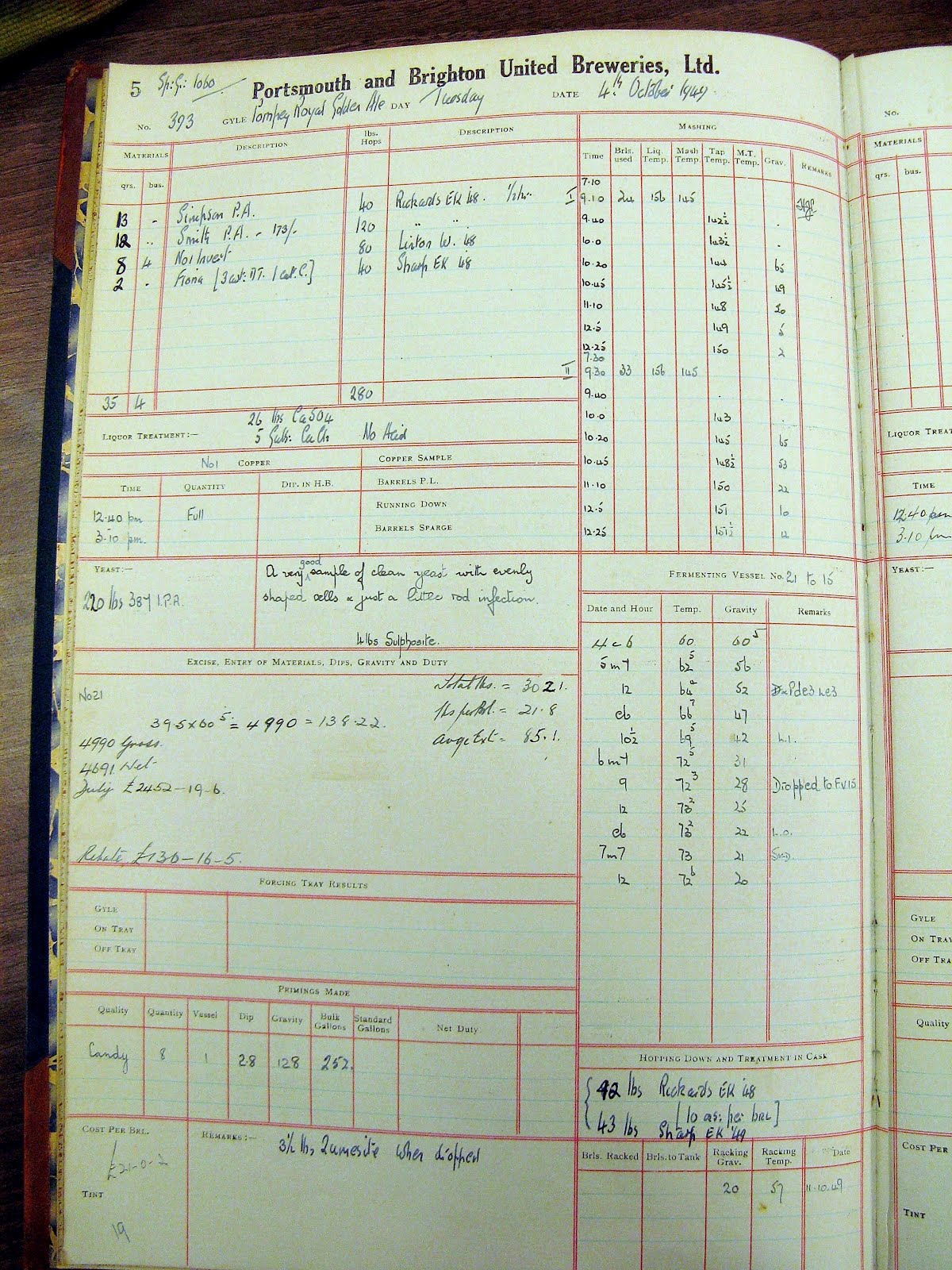
Philip Eley’s notes had already confirmed that P&BUB had considered “’baby’ sized bottlings of Pompey Royal” as early as 8th March 1949. The minute book for 12th October 1949 states “Pompey Royal ‘Golden Ale’ to be marketed from 14th November [of that year] at 12/3d per dozen halfpints and sold to public at 15/-; usual discounts to free trade”. The brewing book for the period December 1948 to September 1949 is lost, but on Tuesday 4th October 1949 the Head Brewer has written Pompey Royal Golden Ale at the top of the page (below left) for what is possibly the second brew of the beer, still with a specific gravity of 1060˚ but now with a somewhat changed recipe.

According to Philip Eley’s extracts from the 1952 minute books for February and March, the brewing report showed a “high overall loss due to bad results for Pompey Royal”. Whether this refers to a financial loss due to poor sales or to a problem in the production process is unclear. There is no mention of matters such as infections in the brewing spec for Pompey Royal on either the 7th January or 5th March 1952. In any case, Pompey Royal was brewed from October 1949 onwards in roughly monthly or two monthly intervals at least up until 4th May 1954, which is the last record available in the existing King Street brewing books.

I am not disputing that Pompey Royal Golden Ale was brewed during the occasion of the Queen’s coronation - a brew took place on 30th May 1953 - and may have been released as a Coronation Ale. But a beer of that exact name and original gravity was brewed and marketed by 1949 with the first ever brew of Pompey Royal having taken place in October 1948, more than three years before the death of King George VI. Philip Eley suggests that Brickwoods replaced bottled United Pompey Royal in 1962, and this would leave the name available for the re-branding as Pompey Royal of cask Brickwoods Best in the late 1970s.

Sources:

Eley, P. (1994) Portsmouth breweries since 1847, The Portsmouth Papers, 63, Portsmouth: Portsmouth City Council Civic Offices.

Personal email correspondence from Philip Eley to David Muggleton, 15th November 2011

Portsmouth Museums and Records Services, National Archives, Portsmouth & Brighton United Breweries Ltd, King Street Brewing Book 1948, 412A/7/33, http://www.nationalarchives.gov.uk/nra/onlinelists/GB0042%20412A.pdf

Friday, 11 May 2012

The Stand Up Inn, Lindfield

It was with great sadness that Dark Star brewery recently announced they would be leaving the Stand Up Inn, Lindfield as they had been unable to agree terms for a new lease that would enable them to cover their costs. The last day of trading was Sunday 29th May 2012. The following article on the pub was adopted from The Quaffer No. 26, June 2010, Lindfield Libations.

Situated on high ground above the upper reaches of the River Ouse, Lindfield is a village and civil parish in the heart of Sussex a mile north-east of Haywards Heath. It was first documented in 765 AD as a Saxon settlement, Lindefeldia, meaning ‘open land with lime trees’. Pollarded lime trees still line the picturesque High Street, a designated conservation area with over forty medieval and post-medieval timber-framed houses. By far the best pub in the village, at 47 High Street, is the Stand Up Inn.

Its distinctive timber framed shop-like frontage has small paned windows with dimpled glass. The left side, formerly Lloyds Bank, has exposed brickwork, thin timber framing and wood laminate floor. There is a bar billiards table and a dartboard to the rear. Beamed and arched ‘walk-throughs’ divide what is otherwise an open-plan right-side room with white plastered walls. Load bearing ceiling beams are lined with numerous pump clips. Chunky ‘rustic’ furniture and scrubbed tables stand on well worn carpet. Cushioned seating is in the window sill; benches are out in the paved and narrow back yard. A compact servery with plain hardboard front resides at the right. The name of Fanny Sara Durrant lives on in the old signboard next to her photograph above the counter and thereby hangs an interesting tale.

Sara’s husband, Edward Durrant had built the Stand Up by the 1880s as a beerhouse, primarily for the workmen of his brewery. Its name arose from the lack of chairs and tables in the bar, for Edward was an early pioneer of what was later to be called ‘perpendicular drinking’. This term was a disdainful one when it was employed by the evangelists of public-house ‘improvement’, for drinking while standing at the bar counter was seen to encourage copious consumption. Edward’s aim was not, however, to get his workforce to drink more but to hasten their departure.


Durrant’s brewery at No. 49 was located just to the rear of the passageway that connected the Stand Up to Edward’s other business, his drapery, grocery and glassware shop, and he wanted his men to promptly return to their duties, not sit lingering over a pint and game of dominoes. “Let ‘em stand up and drink up!” he was reported to have said. As the Harvest Beer at 2d a quart was disparagingly known as ‘Apron Washings’ the men might not been too concerned at having their daytime drinking curtailed; although a more palatable sounding London Porter and Double Porter were reputed to have been brewed, while locally advertised at 1s a gallon was a Family Bitter Ale.

The only Durrant’s Ale that readers may recall is the one brewed by Dark Star to commemorate the centenary of the closing of the brewery in July 1906. Upon the death of Edward in 1902, Sara had owned and run the Stand Up with son Bartley acting as the brewer until he emigrated. Durrant’s Brewery was finally sold with its four pub estate on 29th September 1909 to Ballard & Co. of Lewes. (Ballard & Co was taken over in 1924 by Page and Overton’s Brewery Ltd. This Croydon-based company was acquired five years later by Hoare and & Co Ltd, of London E1 who, in turn, were swallowed up in 1933 by local rivals Charrington & Co Ltd.) The Durrant brewery buildings became an extension to the family home and shop. From 1988-1999 they housed Ray Leworthy’s wireless museum. Now converted into a high quality residence, ‘The Old Brewery’ was recently on the market at £545K, perhaps not so high a price to pay for the privilege of living in Lindfield next door to the Stand Up Inn.
 

It was not to be until 1965 that Ye Olde Stand Up Inn, as the wine and beer house it was then tweely called, received a full licence. That was in the days of long-serving tenants Fred and Nellie Lambert when the interior was two small rooms. It had been owned by Charringtons from 1933 until a Noel McNally acquired the freehold in 1982 and changed its name to the Linden Tree after the mature lime tree outside. Noel also refurbished the interior on the grounds that “you could have had ballroom dancing behind the bar, but there was no room for the customers”. As the Linden Tree it was listed in the CAMRA Good Beer Guide from 1984-88 and 1990-2003. The Lloyds Bank property on the left closed in 1999/2000 and was incorporated into the pub c. 2002. The interior was modernised again by Dark Star upon their taking over the pub in October 2005 and restoring its original and most loved name.

Good Beer Guide-listed since 2005, this regular on the local CAMRA branch Ale Trail has three handpumps for Dark Star beers (Hophead, Best and Original on a spring visit) and three more for interesting guest ales such as Red Squirrel IPA, Hopdaemon Incubus, Shardlow Golden Hop and Salopian Shropshire Gold. Having been local CAMRA branch Country and Village Pub of the Year three times in the past, it is now the branch 2010 POTY overall runner-up. CAMRA POTY awards at branch, regional and national level have also been won for the cider and perry range. This on the last visit consisted of Moles Black Rat and Westons Old Rosie Cloudy Cider on handpump, Westons Country Perry on handpump, and, from Taunton, Sheppy’s Farmhouse Cider on gravity. Not only beer festivals but cider and cheese festivals are held regularly at this outstanding village pub.

Thursday, 3 May 2012

Adopt a Mild for May: Anchor Springs Mild

The Campaign for Real Ale (CAMRA) is asking people to adopt a mild for the month of May and persuade others to go out and try it. Although outselling bitter in 1950s Britain, mild became an endangered style during the 1990s but has once again regained popularity. This resurgence owes much to CAMRA’s Mild in May campaign.

Being a member of CAMRA’s Beer Styles Working Group and the Brewery Liaison Officer for Anchor Springs Brewery of Littlehampton, West Sussex, I made the not too difficult decision to promote and recommend Anchor Springs Mild.

At 3.8% ABV, 1045.5° OG, this is a fruity, full-bodied version of the style. Dark-brown and tawny-hued it is brewed with Pale, Crystal and Chocolate malts and hopped with Fuggles, Target and EKG. A slightly-sweet initial taste has light fruit and chocolate notes leading to just a hint of liquorice in a lingering finish.

Anchor Springs beers are regularly available at both the Spy Glass Inn, Marine Parade, Worthing, and the brewery tap, the Crown Inn, High Street, Littlehampton. Anchor Springs: a range of quality, premium beers to suit different palates for the discerning drinker.