Friday, 24 February 2012

The Murrell Arms, Barnham

This classic village pub was built c. 1750 as a farmhouse by William Murrell, who owned much of Barnham. Its Georgian brick frontage is covered in Victorian stucco and has recently been given freshly painted traditional signage. The Murrell Arms became a pub in 1866 after the arrival of the railway two years previously caused village trade to prosper. The full licence was granted not without opposition from the Railway Inn, the Vicar and Churchwardens. The interior is little altered in the 47 years since the previous, long-serving licensees Mervyn and Daphne Cutten took over.

The Public Bar on the right was two very small rooms in the distant past and retains very old half panelling with some wall benches and a circa century-old curved counter at the rear. The fireplace, front counter and two small bar backs are at least forty years old. The middle area was originally a Jug and Bottle where a partition has been lost. Behind the servery is the cellar with casks on stillage. This area was at one time the living quarters.

The Stable Bar on the left, entered through a vestibule, has very old half panelling and two old fireplaces. Originally a stable, it was converted c. 1910 to a wooden Club Room with a glass covered walkway to the Public Bar. There is evidence of where a partition once divided the room in two and the barrel-counter (pictured above) replaced a hatch. Note the ceramic buttons with numbers on the doors.

The walls are covered in all manner of curios and artefacts collected by Mervyn Cutten (who died in 2006) and these were purchased from Daphne on her retirement last year by the incoming, present licensees Ryan and Heather Mayo. In the Public Bar is the rare game of Ringing the Bull. Beers are from the Fuller’s range with weekend guests. The Murrell Arms, Yapton Road, Barnham, West Sussex, PO22 OAS, tel. 01243 553320.

Sources:

Cutten, M and May, V. (1992) The Mill and the Murrell: A Brief History (Eastergate: Beaver Print & Publicity Ltd)


Tuesday, 7 February 2012

Treasure of a Beer

We are delighted to announce that Hammerpot Bottle Wreck Porter has been awarded Gold in the Porter category at CAMRA’s National Winter Ales Festival, at Manchester, from 18-21 January.


This superb beer, named after a 19th century shipwreck off the Sussex coast, found to be carrying hundreds of bottles of porter, was first brewed in 2007. Since then it has won many Beer of the Festival prizes and four regional awards from both CAMRA and the Society of Independent Brewers (SIBA). Although several of their other beers have also won awards, this is the first national award to be received by the brewery. Lee Mitchell, the Head Brewer at Hammerpot said that, “despite not being driven by awards it is very nice to be recognised and it reflects the efforts of the whole team here.”


Based in Poling, near Arundel, West Sussex, Hammerpot Brewery was established in 2005 by Lee (pictured left with his wife at the 2010 Worthing Beer Festival) with the intention of producing distinctive, quality craft brewed beers. They now produce at least twelve different beers throughout the year and continue to pursue those same aims.

With their 5-barrel plant, Hammerpot are a micro brewery in the truest sense and are delighted to be able to show that smaller end of the independent brewery sector can make beers worthy of national recognition. This award confirms what real ale drinkers in Sussex have long thought: that in Hammerpot Bottle Wreck Porter we have a great beer that is worthy perhaps of even international recognition. This golden achievement is testimony to the superb quality of this outstanding porter. Our congratulations go to all at Hammerpot Brewery.

http://www.hammerpot-brewery.co.uk/home.aspx

Wednesday, 25 January 2012

Truman’s Asks: “Find us a Brewery”

Truman’s – the classic East London beer brand – is asking the capital’s ale drinkers to help find a site for its new brewery. James Morgan, who re-founded the company alongside Michael-George Hemus in 2010, commented: “We’ve been looking very hard for a site over the last year and despite a few near misses, we’re still looking. But East London is a big place and not every potential site is currently on the market. As such, we thought it would be wise to ‘crowdsource’ our search and tap into the local knowledge of East Londoners.”

A year’s supply of beer – 500 bottles of Truman’s Runner ale – is on offer to the person that finds the eventual site. A 12-bottle case of Runner will be given to anyone that sends in details of a site of real interest and all of those that enter will be invited to the opening party at the new brewery. Michael-George added: “We do have a bid with the Olympic Legacy Committee to take over a part of the Olympic site after the games. A number of potential developers have expressed an interest, but we are talking 2013 before we even get a spade in the ground. And we are determined to be brewing Truman’s back in London by the end of 2012.”

Truman’s was brewed in East London for more than 300 years, most recently at the iconic Black Eagle Brewery in Brick Lane, where production stopped in 1989. The building is now home to London’s creative communities. Following its re-founding in 2010, Truman’s has been brewed under licence. Potential sites must meet the following criteria:

  • In East London (boroughs of Hackney, Tower Hamlets, Waltham Forrest or Newham)
  • Commercial premises
  • Between 6,000-8,000 square feet (2 to 4 tennis courts in size)
  • Good access
  • Part of the site must be convertible to ‘double height’ (five metres and above)

Entries can be made by sending an email to brewery@trumansbeer.co.uk. Please include the address of the site (including post code), current status (leased, vacant, derelict, etc.) and the contact number of the site owner (if known). The more details provided the more likely the entrant is to win some beer. Entries must be in by March 1st 2012. Further details can be found on the Truman’s blog. http://www.trumansbeer.co.uk/. For images, quotes and samples – or more information on the re-establishment of Truman’s - please email trumans@trumansbeer.co.uk or phone James Morgan +44 (0)7816 667 706

Notes:

Established in 1666, closed in 1989 and re-established in 2010, Truman’s is the classic East London beer. Once a heavyweight of British brewing – by the late 1800s it was reportedly the world’s largest brewer – it fell victim to the “merger mania” of the 1960s and 70s. Truman’s held on to be one of the last independent brewers in London, but in 1971 it succumbed to an aggressive bid. Eighteen years later, after a long period of decline, its breweries were closed and its pubs sold off.

In 2010, Truman’s Beer was re-established by two local beer enthusiasts, James Morgan and Michael-George Hemus. Many a day was spent examining the records of the London Metropolitan Archives to find the original foundations on which it should be rebuilt. The goal of the business it to make Truman’s a great name in beer once again – by going back to basics, brewing great beer and being part of the local community. Truman’s Runner is the flagship beer of Truman’s and is a copper coloured, well rounded 4% bitter. ‘Runner’ was traditionally the name of a brewer’s easy drinking, session beer – available to everyone everywhere. Truman’s Runner is our interpretation of this custom.

Thursday, 19 January 2012

The Clyde Arms, Brighton – Once a House of Repute in Sussex

It is my intention to identify all the pubs that were houses of the Kemp Town Brewery, Brighton. A main reason for my interest in this brewery is that they were evangelists for the cause of public house improvement during the interwar years and used local architect John Leopold Denman to execute many of their designs. Some of the buildings that their pubs inhabited are, unfortunately, no longer with us, having been demolished.

I did at least manage to visit the Ball Tree, Sompting some years before its recent demise, the subject of my Blog dated 24th October 2011. Not so for the Clyde Arms, 25 Bristol Gardens, Brighton. Hence, I have to rely on old photographs.
 
The Clyde Arms dates from the 1870s when Bristol Gardens was called Sussex Street, the pub being at No. 5. In this 1927 photograph from the James Gray Collection the pub remains a recognisably Victorian building but this was just a year before it was rebuilt. The fascia advertises KEMP TOWN BREWERY ENTIRE and identifies the landlord as F. HUGGETT. More specifically, as the Trade and Post Office Directories of the period tell us, he was Frank R. Huggett, who took over in 1927 from Alfred Francis and by 1935 was succeeded by a George S. Huggett, obviously a close relative.

The application and plans for the rebuilding were lodged at the Brighton Borough Petty Sessional Division, date 20th December 1927, now stored at the East Sussex Record Office, Lewes. The client was Messrs Abbey & Sons & Kemp Town Brewery, the Architect or Builder, Denman & Son.

The above, second photograph of the pub, appears in the brewery’s own publication, In and Around Brighton: Houses of “Repute” in Sussex, was taken after the rebuild and shows a characteristic classical neo-Georgian design by Denman. What is now advertised is the brewery’s Dolphin brand of beers. The modelled panels either side of the central window on the first-floor front elevation may depict dolphins. Note the east-facing, bow-fronted wine office, typical of rebuilt Kemp Town Brewery pubs of this period.

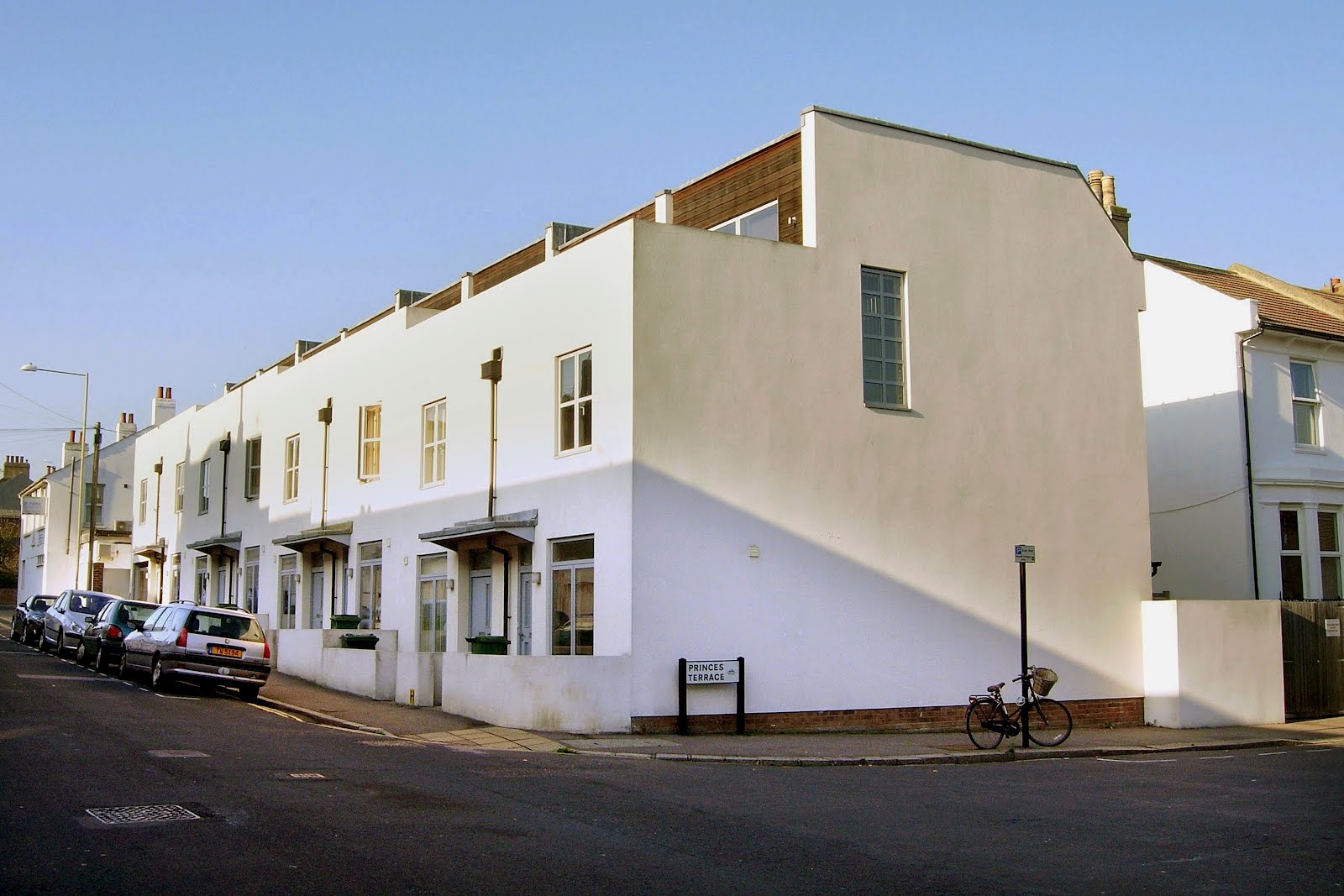
In late-1930 an extension to the opposite, west side was built, again by Denman & Son. The pub remained in existence until some several years ago. I must have jogged past it on numerous occasions in the late 1980s but there was no reason for it to draw my attention at that time. The colour photograph shows the new flats standing on the site today. The rear gable wall of the first Victorian house in Princes Terrace (right edge of today's view) is presumably that just visible on the right edge of the James Gray photograph.

Sources:


Tuesday, 6 December 2011

Sign of the Seagull

The pub that used to be the Seagull is in Broad Street, Old Portsmouth, Hampshire. It was built for Jewell's brewery in 1900 and ceased to be a pub in 1970. An Estate Agents now occupies the premises. My own photos of the pub are intended to highlight the valuable photographic resource that is "RIBApix, a growing database dedicated to providing you with exceptional and unique images from the collections of the British Architectural Library at the Royal Institute of British Architects, the world’s most extensive visual archive devoted to architecture."

The black and white photograph from the RIBA collection shows the mosaic wall sign in 1952, taken by Reginald Hugo de Burgh Galwey, (1917-1971).


Click on my exterior photograph to see that the attractively decorative pair of "Jewell's Ales" lower-windows have since disappeared. Also to be noted is the distinctive modelled seagull under the corner turret. The RIBApix collection has a close-up, again taken in 1952 by Reginald Hugo de Burgh Galwey. Compare his image with my own (below). The half-timbered and turreted exterior design is characteristic of the Portsmouth pub architect Arthur Edward Cogswell (1858-1934) and the Portsmouth Pubs website notes that The Seagull "is of very similar external design to the Florist on Fratton Road ", also a Cogswell pub. Nonetheless, the Seagull is listed on excellent website of Portsmouth local historian, Stephen Pomeroy, as having been designed by local architect George Charles Vernon-Inkpen, with a date of 1904.


The following abbreviated information on this architect is taken from Pomeroy's website. "George Charles Vernon-Inkpen (1857-1926) was born at Bethnal Green, the son of a carpenter, and had a practice in London in 1879, but in 1881 he was lodging in Oving, probably because his practice from 1882 to 1890 was at The Cross, Chichester. In 1887 the practice of Inkpen and Stallard (Stallard is unknown and the only recorded work of the practice was in the Old Kent Road, London) appears in Southsea and Havant and in 1891 Inkpen was living in Southsea. In 1893-94 with a partner called Swinburne he had addresses in Midhurst and Bognor. Swinburne has also not been identified for sure, but Frank Swinburne (b. 1863), architect and surveyor of West Street, Emsworth, who was also surveyor to Warblington Urban District Council, seems a likely candidate. He was a Londoner by birth, but later lived with his parents in the town; in 1891 all three of them were supported by their own means".

"By 1895 Vernon-Inkpen (his use of the hyphenated form does not appear earlier) was alone at 6 Kings Road, Southsea and in that year his status was sufficient to be elected a Borough Councillor, which he remained in 1899. During this time he moved, for in 1898 he was living, still on his own, at 75 Kings Road, though in 1901 he was at Idsworth, near Petersfield. Between 1914 and 1926, when his business address was 40 Commercial Road, Southsea, he was also without a partner, yet a year after his death, there was a branch of Inkpen and Rogers (who must have been the last of his elusive partners, if only briefly) in South Street, Chichester. Inkpen designed schools, and domestic, commercial and industrial work, mostly in the Portsmouth area or Dorset. In 1898 he proudly announced his possession of a Special Diploma in Sanitary Sciences."


Sources:

http://www.ribapix.com/index.php


http://www.portsmouthpubs.org.uk/


http://homepage.ntlworld.com/stephen.pomeroy/local/locarch.pdf

.
http://www.sussexparishchurches.org/content/view/323/40

.


Friday, 25 November 2011

For People Who Like Real Ale In Sussex – And Beyond


Comrades! Join the Sussex Drinker revolution. Follow us into Surrey, London, Kent and Hampshire as the cover of our autumn issue implores. In fact, follow us from anywhere in the globe if you are registered for a Facebook account. Just enter Sussex Drinker into the search box at the top of your Facebook page, bring up the magazine’s page and ‘Like’ us. This will enable you to receive news feeds from us and, conversely, allow you to feed us with news items – particularly useful if you are a pub holding a beer festival, a brewery promoting new products, or a customer wanting to update us with positive new developments on the Sussex real ale and pub scene.

“Sussex inns are as numberless and glorious as stars in the galaxy”, wrote Denzil Batchelor, journalist, bon vivant and author of The English Inn (London: Batsford, 1963). Why not come and visit Sussex and explore the glorious inns and pubs of our real ale scene for yourself? Or heed the clarion call on the cover of our winter issue. With an inspirational nod to the Russian artist Alexander Rodchenko you are urged to attend any or all of our six CAMRA Beer Festivals in All Areas of Sussex. The next one is the big one, the Sussex CAMRA Branches Beer & Cider Festival at Hove, from 8-10 March 2012. For details of opening times and ticket prices see the advert (left).

Over the past two years the Sussex Drinker has become bigger (up from 32-40 pages), better (one of the outstanding CAMRA magazines in the UK) and more popular than ever before (an increased print run from 5000-12000 copies).

This would not have been possible without the superb design skills of Daniel Speed (Tamoko Design). To meet unprecedented demand we now regularly deliver outside of our county boundaries, as shown by the front page photos of the autumn issue: reading clockwise from top left, Bricklayer’s Arms, Putney; Hole in the Wall, Southsea; Grove Tavern, Tunbridge Wells; White Horse, Parsons Green. If you would like to advertise your pub, brewery or business to this wider readership in the Sussex Drinker, please contact Neil Richards MBE of Matelot Marketing, responsible for the production side of the magazine. Neil can be contacted on Tel: 01536 358670 / Mob: 07710 281381 / Email: N.Richards@btinternet.com

As for regular features in the Sussex Drinker, the ‘Sussex Pub Scratchings’ news pages has contributions from our readers; the latest ‘Bus to the Pub’ around Sussex programme is organised by Arun & Adur branch member, Stuart Elms. ‘Beer Festivals and Other Delights’ are our diary dates (for which inclusion is free).

‘History and Heritage’ is a celebration by yours truly of a CAMRA National or Regional Inventory pub in Sussex or some other aspect of local pub and brewery history. Web sites on the history of pubs in Worthing and in Hastings and St. Leonards have featured in recent issues.

‘Cider House Notes’ is by our Regional Cider Coordinator, Jackie Johnson; ‘Star Behind the Bar’ is an informal introduction to one of our pub licensees; and there are ‘LocAle updates’ on our pubs that stock locally-sourced real ales from breweries within a designated radius.

‘Bru News’ consists of up-to-date reports by CAMRA Brewery Liaison Officers on all of the breweries in our county, while ‘Spotlight on Breweries', as seen below, is for more specific, in-depth news items.


If you are unable to pick up a hard copy of the Sussex Drinker in our usual numerous outlets, a PDF version is accessible at the following CAMRA branch web sites:

http://www.westernsussexcamra.org.uk/files/drinker_2011_04.pdf


Monday, 14 November 2011

A Holy Alliance

The flat buzzer sounded and there at the door was the postman with a parcel for me. I wasn’t expecting a delivery so peered at the box label while I signed for the item. It was from those nice people at the St Peter’s Brewery in Suffolk. Inside were two of their iconic oval 500mm beer bottles - one The Saints Whisky Beer, the other Suffolk Smokey - with an accompanying press release. A delightful present such as this deserves some reciprocal publicity on the Blog, so here we go.

Suffolk brewer St Peter’s has crossed the county border into Norfolk to team up with the English Whisky Co., England’s first registered whisky distilling company for over a century. Their production facility, St George’s Distillery, is based in the historic Breckland area of Norfolk, just thirty miles from St. Peter’s. The above photograph, taken at St George’s Distillery, shows David Fitt, Head Distiller at St George’s, and Mark Slater, Head Brewer at St Peter’s Brewery.

The Saints Whisky Beer is produced by St Peter’s Brewery with the same peated malt used at St George’s Distillery in their whisky production. Following fermentation, English Whisky Co.’s Chapter 9 peated / smokey single malt whisky is added, before bottling, to produce a superbly balanced 4.8% beer, rich in flavour with smokey overtones from the peated malt.

Commenting on the new product, Andrew Nelstrop, Managing Director of the English Whisky Co. said “we are delighted to be working with St Peter’s Brewery to develop this excellent new and differentiated product. With St Peter’s penetration in worldwide markets, we hope that this new produce with also introduce customers to the English Whisky Co. and our range of whisky products." Colin Cordy, Managing Director of St Peter’s added that “in our consumer trials we have had a very positive reaction to The Saints Whisky Beer. Moreover, distributors in our thirty-two export markets are very excited about this addition to the St Peter’s award-winning range of beers.”

The Saints Whisky Beer will be launched exclusively in the UK in 150 selected Waitrose stores and will also be offered by the UK’s leading on-line grocer, Ocado from early October. The beer will also be available from the St Peter’s on-line shop http://www.stpetersbrewery.co.uk/ and will be sold at St George’s on-site shop and on their webshop http://www.englishwhisky.co.uk/.

Here endeth the press release; back to my own voice. I’m fond of single malt whisky and found very pleasantly enjoyable the delicate balance of St Peter’s beer and St George’s whisky in The Saints Whisky Beer. I can appreciate that the point of the press release is to promote this particular St Peter’s product and, hence, the holy alliance with St George’s, but I thought that Suffolk Smokey deserved more than its two lines, almost as an afterthought at the end of the release. Strong flavours, such as the smoked bacon prominence of Suffolk Smokey, really appeal to me. For further information on the beers please contact:

St Peter’s Brewery: Colin Cordy
Tel: 01986 782322
Email: colin@stpetersbrewery.co.uk

English Whisky Company: Andrew Nelstrop
Tel: 01953 717939
Email: Andrew@englishwhiskycompany.co.uk